The allotment that Margaret and I have looked after in Cam for the last 18 years is beginning to look very promising after the long cold winter. Our broad beans are just showing their heads and promise a good crop, voles and pigeons permitting. Margaret’s narcissi are blooming profusely, and a particularly early rhubarb given to us by neighbor Roy Chinn is threatening numerous crumbles.
However, it is the emergence of my ‘big fat female’ which has given me my biggest thrill. Each year one particular carpet proves to be the sun lounger of choice for our slow worm matriarch and for a couple of weeks she can be found hiding beneath this cover every day, warming gently in the spring sun. She has been there now for 10 days and it will not be long before her fabulous brazen babies spread quietly across our plots. Sheer magic!
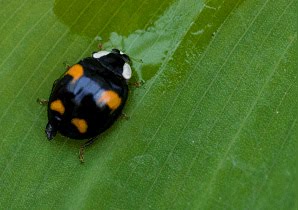
Not quite so magical are the forty or more harlequin ladybirds that I have just seen basking in the sun here at Robinswood Hill. It was only in 2006 that Margaret saw the first adult ever recorded in Gloucestershire in our garden (her picture is above). Now they are widespread and the colony that I have been watching has passed the winter sheltering beneath an information sign.
Harlequins are attractive, but they are not native and are as partial to dining on our native ladybirds as they are on any other insect of the right size. The spread of this insect is a text book example of an animal invader and is a frightening indicator of what might be in store for our native wildlife beset by climate change and isolated on shrinking habitats.
The systematic recording of this alien is extremely well recorded in www.harlequin-survey.org I recommend this site as an example of how just how good species recording can be when the power of the web is properly utilized.
Spring has many messengers, but for me the chiffchaff is the most powerful both aurally and symbolically. This small LBJ (little brown job to quote birder jargon) makes a huge journey for such a tiny creature. Chiffchaffs winter in southern and western Europe and North Africa. In common with other spring migrants, their arrival is timed to coincide with the rapid increase in their insect food that occurs as temperatures rise and days lengthen.
My chiffchaff gave only a few experimental calls this morning and was definitely out of practice when compared to the robins, wrens and dunnock that were in full song. But perhaps I might be a bit off key if I had just made the same journey using just my own energy and determination. Wikipedia provides a good explanation of the ways of this little warbler.
However, no matter how much I might be thrilled by my chiffchaff, it falls into second place as an unusual experience compared to that relayed to me by my wife last week. Sitting behind my desk, churning through emails and papers, I was amazed to hear from Margaret that she had seen a water rail foraging on the ground under our bird feeders!
The water rail (Rallus aquaticus) is a slender marsh bird of the family Rallidae (order Gruiformes), native to most of Europe and Asia. Its length is about 28 cm (11 inches), and it has a moderately long beak. The sides of the bird have black and white bands. The name water rail also is used as a general term for the larger group, or tribe, to which R. aquaticus belongs. Rallus aquaticus can be distinguished from the tribe Rallini by its relatively long beak.
Working for a Wildlife Trust, the proud manager of four fantastic square miles of Gloucestershire, does not mean that I either have the time to visit these 60 nature reserves or be successful in spotting the shy or rare residents. My local patch is where I get the most pleasure from wildlife sightings. Margaret’s water rail was only 100 meters from my chiffchaff. The area is an overgrown field with brambles, hedgerow trees, two fantatstic oaks and the clean and sparkling River Cam. This emphasises the real value of green sites in towns and villages. Nature reserves are important but they are part of the rich mosaic of sites that are critical if wildlife is to survive and people are to benefit spiritually from experiencing it.
Oh and I am still envious of Margaret’s bird – I have never seen one!